
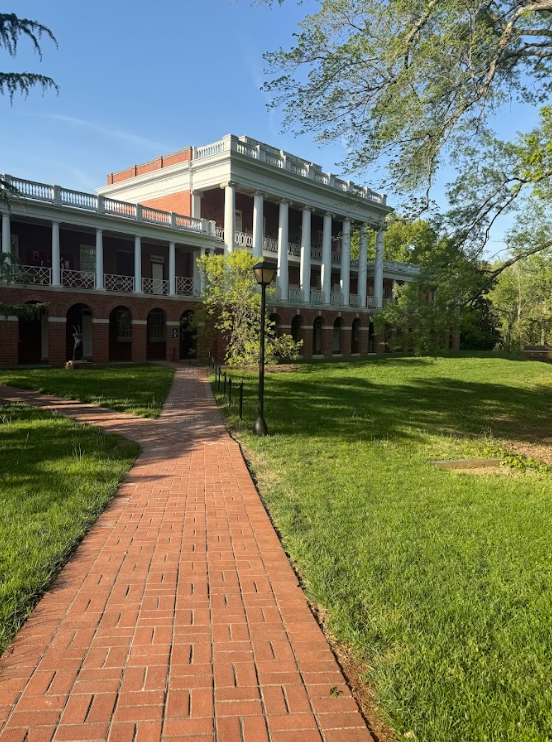
Today I spent an hour walking around campus. It was beautiful outside, the sun was warm and I always love how campus looks in the spring. The sun illuminates the grass so much that it has a bright green hue to it. Campus to me always feels so much more inviting in the Spring as all the flowers have bloomed and students are enjoying time outside usually on Ball Circle. As I was walking I heard many animals. I heard squirrels chasing after one another, I heard birds chirping, and people talking. You may be asking, why did she include people as one of the animals listed? Well as I was walking around I found myself engaging in critical rhetoric, a term set forward by chapter five in our textbook titled “Environmental Advocacy Campaigns”. While I was walking I engaged in critical rhetoric by questioning why society does not see humans as animals. (Pezzullo and Cox, 90) The argument that most likely would be made is that humans can communicate with each other and are more intelligent than other forms of life. I fully disagree with this notion and find that it disconnects humans from nature. I find that humans and animals actually act quite similar in their everyday lives. For example, a mother bird will go back to her nest to feed her babies. Humans, I would hope, follow the same patterns. In Maria de La Bellacasa’s book, Matters of care: Speculative ethics is more than human worlds, she offers the question if care should be, “a moral obligation”. (Bellacasa, 1) I would argue that it should be due to the similarities that humans share with the animals around them. This perspective offers a familial relationship between all animals. For this reason I find it as an obligation that humans should be devoted to preserving the environment.
Bibliography:
Read: de La Bellacasa, Maria Puig. Matters of care: Speculative ethics in more than human worlds. Vol. 41. University of Minnesota Press, 2017.
Pezzullo, Phaedra C. and Cox, Robert J. Environmental Communication and the Public Sphere . Sage Publishing, 2006.
Leave a Reply